Sales funnel for a small service business: five stages, where requests drop out and what to track
A sales funnel for a small service business has five stages: enquiry, reply, booking or meeting, proposal, payment. Draw them as five columns, put every request in exactly one column, and note two numbers for each: how many requests are in it, and how many days the oldest one has been there. That is the whole method. A spreadsheet can hold the list, but it will not tell you that three requests have been sitting in "reply" since Tuesday. A funnel in a CRM shows every stage on one board, with no copy to update.
Funnel, pipeline, list: how we use the words
The three words get mixed up, so here is how we use them. A list is rows in a spreadsheet: somebody wrote a name down, and nothing says what happens next. A pipeline is the working board, where every request is a card with an owner, a stage and a next task. A sales funnel is the same board seen from above: how many requests came in, how many reached each stage, how many dropped out on the way.
In a small business one board does both jobs. You do not need sales pipeline software with a hundred settings; you need stages that match your work and somebody who looks at the board every day. Funnel pages and ad campaigns that bring enquiries in are a separate topic. We start when the enquiry arrives.
The five sales funnel stages and where requests drop out
Here they are in the order a customer goes through them. Rename them in your own words: a workshop says "inspection", a clinic says "appointment".
Stage one is the enquiry: a WhatsApp message, a form on the website, a phone call, an Instagram DM. Requests drop out here when they land somewhere nobody looks, like a direct message at nine in the evening or a missed call nobody returns. The rule: every enquiry becomes a card the minute it arrives, whatever the channel.
Then comes the reply, the first answer that says something useful, not "Hello, what do you need?". The quiet damage happens in the gap before it. Pick a limit and write it where everyone can see it: if nobody has taken a request within an hour of working time, the owner of the board takes it.
Next, a date in the diary: an appointment, a site visit, a call. Requests drop out on "let me check and I'll come back to you", said by either side. Offer two concrete slots instead of "when would suit you?" and put the date on the card.
The proposal is a quote or a written account of what you will do and for how much. Silence after a quote is not a no. Sometimes it is an unread message. Give the card a next task with a date: "ask on Thursday whether the quote arrived".
Last, payment: a deposit, an invoice, money in the account. It is easy to call a job finished when the work is done, but the funnel finishes when the money arrives. An invoice that was sent and never checked is a request that dropped out at the last step.
Sales funnel examples: the same five stages in three sample businesses
| Stage | Hair salon | Private clinic | Repair workshop |
|---|---|---|---|
| Enquiry | Instagram message about colouring | Website form asking for a check-up | WhatsApp photo of a damaged part |
| Reply | Time range and what to expect | Available times, sent as a message | Questions about the model and the fault |
| Booking | Appointment in the diary | Appointment booked, reminder set | Drop-off day agreed |
| Proposal | Price of a longer treatment confirmed | Treatment plan and price, for larger work | Quote for the repair |
| Payment | Paid at the salon | Paid after the visit | Invoice paid on collection |
Two cautions. A stage can be empty for some customers: a simple haircut does not need a proposal, so the request skips it. Keep the stage for the jobs that do need one. And resist adding stages. Eight columns look thorough, and then nobody moves cards across them. If you cannot say in one sentence what moves a request from one stage to the next, merge the two.
What to track: two numbers per stage
The first number is how many requests stand in each stage today. It shows where the pile is. The second is how many days the oldest one has been there. It shows what is stuck. For example, twelve requests that all arrived this morning are just a busy morning; three requests that have not moved for nine days are a problem. The figures are made up, only to show the difference.
Add one more column outside the five: lost. When a request goes there, pick a reason from a short list: price, no answer, chose someone else, not something we do. After a few weeks that column tells you more about your business than any benchmark.
You can also work out what share of requests moves from one stage to the next, once you have a few weeks of your own data. We do not quote typical conversion rates, because they would belong to other people's businesses. For a weekly routine, see six numbers to check every Monday.
Spreadsheet or CRM for the funnel
A spreadsheet works for a while, and we say so as people who build CRMs. While one person handles every request and they come in through one or two channels, five columns in Google Sheets or Excel are enough. It breaks when a second person joins, when a copy called requests_FINAL(2) appears, when messages arrive in WhatsApp and nobody types them in. From then on the sheet shows what somebody remembered to write down.
Cloud CRMs with a board view exist, and setting one up yourself is a sensible choice if you have the time. We do not configure other vendors' systems; we build our own. The point where a sheet stops working is in Excel, Notion or Airtable as a CRM, and the money side is in what a CRM really costs a small business.
The Fleetglanz CRM: from a WhatsApp message to a crew on the weekly plan
Fleetglanz is a CRM for a cleaning company in Hamburg. The site is in German.
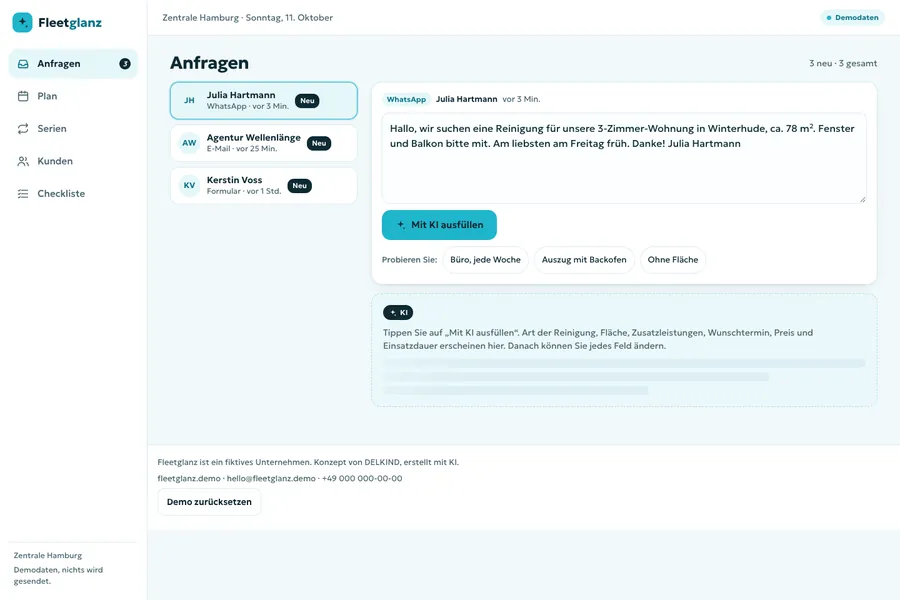
A message arrives from WhatsApp: "three-room flat, 78 m², windows and balcony, Friday morning". One button, "Mit KI ausfüllen" (German for "fill in with AI"), turns the free text into fields: type of cleaning, area, extras, date. Price and duration are worked out at once. When the message gives no area, the form asks for it instead of guessing, and every field can be changed. The order then goes onto the weekly plan: drag it to a crew and a time. A repeating cleaning, weekly or every two weeks, creates its future orders by itself. The crew ticks off a checklist, and marking the job complete prepares a short message asking the customer for feedback.
In funnel terms, the card is the enquiry, the AI-filled fields with a price are the reply and the proposal in one step, and the weekly plan is the booking. For a cleaning company two stages collapse into one, and that is fine: your stages should follow your work, not a diagram. You can open the Fleetglanz project and click through it.
What to do today
- On paper, write your own five stages in the order a customer goes through them. Use your words: "site visit", "fitting", "check-up".
- Take the last 20 requests from WhatsApp, the website form, Instagram and your call log, and put each in a stage. The ones you cannot place are the ones nobody recorded.
- Next to each request in "reply" and "proposal", write the date it reached that stage. The oldest date is your first call this morning.
- Add a "lost" column and a one-word reason for every card that goes into it.
- Set the limit for the first reply, say an hour of working time, and tell everyone who answers customers.
If you'd like, we'll do it for you
We build this as a Mini-CRM: from €480, excluding VAT, in 2–4 weeks. We start with a call about how a request reaches payment in your business, and the pipeline gets your stage names and fields, nothing extra. The website form and WhatsApp are connected, so each request lands as a card with the contact, source, history, notes, an owner and a next task, and you get a WhatsApp message about every new one. AI can answer the customer, with a label saying it is AI, and give the manager a short summary. Which AI features to switch on, we decide at the review. We move your customers over from Excel or Google Sheets and check them with you before launch, write the message templates for your review, and train your managers.
There is no subscription and no fee per user. The data and access are yours, you can export it all to a spreadsheet at any time, and the server is registered in your name and paid for by you directly. Revisions are free until acceptance, and we fix bugs for 6 months free of charge. You pay half to start and half after acceptance. Our experienced specialists work faster with AI tools, which is why the price is lower. Details are on the CRM with AI page. Message us on WhatsApp and we will reply within an hour during working hours.
Sources
- CRM with AI: what the Mini-CRM includes, checked 2 November 2026.
- Fleetglanz: CRM for a cleaning company in Hamburg, checked 2 November 2026.