WhatsApp chatbot for a small business: what it can answer, what the official API costs and where a person takes over
A WhatsApp chatbot for a small business earns its place in three jobs. It answers the questions you answer every day, from your own price list. It takes a booking or a request and passes it on. And it calls a person when it isn't sure. There are two ways to get one. The WhatsApp Business app gives you a greeting, an away message and saved replies, but nothing in it understands a question. The official WhatsApp Business Platform lets a bot or a WhatsApp AI chatbot answer in free form, and Meta bills that per delivered message. Which road fits depends on how many conversations you have and how many arrive when nobody is at the phone.
What a chatbot on WhatsApp does for a small business
Take a dental clinic, a furniture shop, a small carrier. Most of what lands in their WhatsApp is the same ten questions: what does it cost, are you open on Saturday, can I come tomorrow, where is my order. A chat bot on WhatsApp that answers those from your documents gives the desk its afternoon back.
The third of those jobs, handover, decides whether customers like the thing. A bot that says "I don't know, I'm calling the administrator" is more useful than one that always has an answer. It is also where a plain chatbot and an AI assistant part ways. A button-driven chatbot walks the customer down a tree and goes off the point when the question comes in free form. An AI assistant reads the question as the customer wrote it and answers from your documents. A ChatGPT WhatsApp bot wired to your number with no documents behind it will give fluent answers about prices you never set. There is no best WhatsApp chatbot in general, and a WhatsApp Business AI tool is only as good as the documents it reads. The right one answers from them and admits when it can't.
Road one: the WhatsApp Business app
The app has three tools that cover the basics. A greeting message welcomes a new customer. An away message tells them you're offline. Quick replies are saved answers you call up with a shortcut such as /hours or /pricing, so a pre-written response goes out in seconds.
That is not a bot. Every reply still has a person behind it, and an away message tells the customer to wait for morning. The customer who wrote at 23:00 about a slot tomorrow books somewhere else. Our view: if you answer within the hour in working time and your nights are quiet, stay here and spend ten minutes on good quick replies. A bot starts to pay when the same questions arrive faster than anyone can type, or mostly out of hours.
Road two: the official platform, and what Meta charges
Anything that answers on its own runs on the WhatsApp Business Platform. Meta sets the rules there, and they shape what the bot can do.
| Rule | What Meta says | What it means for you |
|---|---|---|
| 24-hour window | The timer starts when a customer messages or calls you; non-template messages can only be sent while it is open | The bot answers freely for a day after the customer's last message |
| Templates | Outside the window you may only send approved templates | No free-form "just checking in" a week later |
| Consent | You may contact people only if they have given you their number or username, with opt-in permission | A bought list is out. Replying to people who wrote to you is fine |
| Opt-out | You must respect requests to block, stop or opt out | One "stop" and the bot goes quiet |
| Human path | Automation must come with prompt, clear and direct escalation paths | A way out of the bot is a requirement, not a courtesy. Passing the chat to a person is one way to give it |
Marketing automation on WhatsApp, broadcasts to a list, is a different business: templates, consent and a billing category of its own. What follows is about answering customers who write to you.
Billing. Since 1 July 2025 Meta charges per message instead of per conversation, and only for messages it delivers. Messages from customers to you are free. Rates depend on the recipient's country and on the category: marketing, utility, authentication or service. Service covers answers to a customer who wrote first, which is most of what a support bot does. Those answers used to cost nothing. According to Meta's developer pricing page, service messages are charged per message from 1 October 2026, with a free tier of 1,000 delivered service messages per business phone number each month. The tier resets monthly and doesn't roll over. Some guides, and parts of Meta's own marketing material, still call service messages free, so read the page with the dates on it.
An example with made-up traffic: 15 conversations a day, four bot replies in each, is about 1,800 messages a month. The first 1,000 are free and 800 are billed. What they cost depends on your country's rate; we won't quote a figure, because rates vary by market and change.
A WhatsApp chatbot platform from a provider sits on top of Meta's, so ask whoever builds yours which charges are Meta's and which are theirs, in writing. When you compare WhatsApp Business automation offers, that line puts them on a level footing.
What the bot says first, and when it calls a person
The first message sets the terms. It says this is an AI assistant, what it can help with, what it passes to a person and how to ask for one. Something like: "Hello, I'm the clinic's AI assistant. I can answer from the price list and book a visit. For anything else I'll bring in the administrator, or type 'human' at any time." Say it that plainly.
Hand over when the answer isn't in the documents, when the customer asks for a person in any wording, when the question is about money someone could lose or owe (a refund, a penalty, a complaint), when the same question comes twice and the answer didn't land, or when the customer is upset.
Then decide, in writing, who takes it and how fast. "The reception" is not an answer. "Whoever opens the shared phone first, and the owner if nobody has within the hour" is. A handover that nobody picks up is worse than no bot: the customer was told someone would come.
An example: a carrier in Łódź
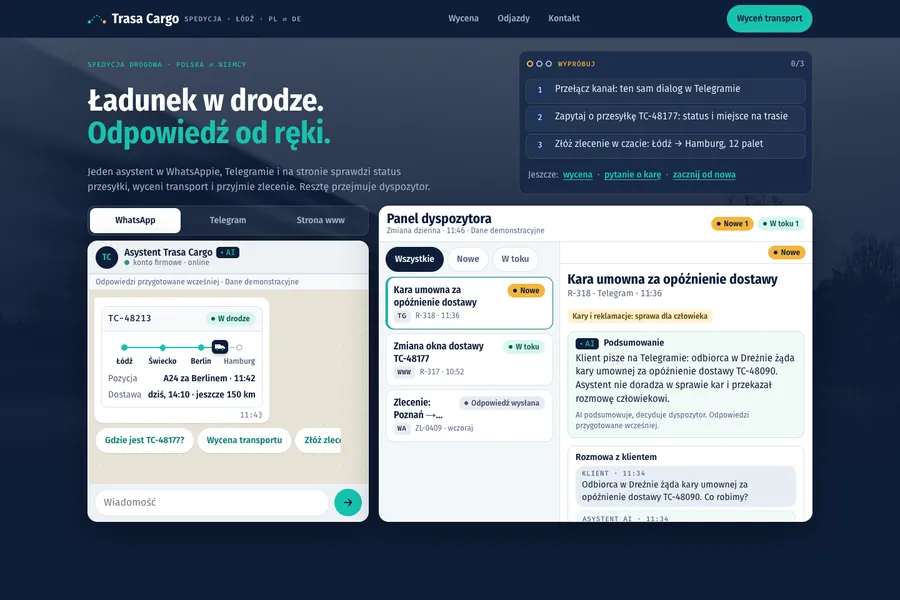
Trasa Cargo is a work from our portfolio: a freight forwarder in Łódź on the Poland–Germany routes. One assistant sits in WhatsApp, Telegram and on the website, with the same conversation in all three. A customer types a shipment number and gets the stage, the town and the expected delivery time on a route diagram. An order comes together as a card, the assistant asks for whatever is missing, and the dispatcher takes the case from a panel and replies as a person in the same chat.
The part to copy is the limit. Ask it about a contractual penalty for a late delivery, or about customs, and it doesn't advise. It says so and passes the conversation to the dispatcher with a short summary written by the AI, and the dispatcher decides. The customer doesn't explain it all again. Price and delivery date are always confirmed by a person. Open the work; the site is in Polish.
What to do today
- Scroll back through a month of WhatsApp chats and write down the ten questions that come up most.
- Put the answers in one document: price list, opening hours, delivery or booking rules. If you can't write an answer down, a bot can't give it.
- In the Business app, set a greeting, an away message and quick replies for the first five questions. Do it even if you plan a bot: the same answers feed it.
- Write the handover rules: five situations, one named person, a time limit.
- Before you talk to any provider, open Meta's pricing page for developers, find your country's rates and ask for every charge, Meta's and theirs, on one page.
If you want, we'll do it for you
We build this as an AI assistant that answers on WhatsApp: from €480, excluding VAT, with no monthly fee. Meta's per-message charges described above are separate from our price. Launch takes 1–2 weeks, and you pay 50% as a prepayment and 50% after you accept it. It begins with a free 15-minute review where you tell us what customers ask.
It answers from your price list, rules and notes, in one channel you choose: a chat on your website, WhatsApp or Telegram. It introduces itself as AI right away. Where the answer isn't in your materials it says so and offers a person, and the word "human" passes the conversation to you or your receptionist. Bookings and requests reach you as a card on WhatsApp.
The price covers a call before we start, your documents loaded and put in a form the assistant can use, a greeting and prompts that we write and send you to review, the tone and limits of its answers, a conversation log, and a test on your own questions before launch. Revisions are free until you accept, and we fix bugs for 6 months after launch at no charge. A voice assistant or booking into your calendar costs extra; we put that price in writing first. The price is low because experienced specialists work faster with AI tools.
Sources
- WhatsApp Business Platform: pricing (Meta for Developers), checked 28 October 2026.
- WhatsApp Business Messaging Policy, checked 28 October 2026.
- WhatsApp Business Platform: pricing overview, checked 28 October 2026.
- WhatsApp Business app features, checked 28 October 2026.
- Onboarding 101: setting yourself up on the WhatsApp Business app, checked 28 October 2026.