Channel manager or your own booking page: how a small guesthouse or holiday rental takes direct bookings
A channel manager for hotels and guesthouses does one job: it keeps the same nights open or closed on Booking.com, Airbnb and every other place you list, so a room is not sold twice. It brings no new guests. Direct bookings come from your own page, where a guest sees your dates, the full price and a way to ask you something. With three to ten rooms the usual order is calendar sync first, a booking page second, and a paid channel manager once double bookings cost you more than the subscription.
What a channel manager does, and what it leaves alone
A channel manager sits between your calendar and the platforms. You block a night in one place and the others close it too. Depending on the vendor, rates and reservations travel the same way, so you open one screen in the morning instead of three apps. For a house with several rooms listed in two or three places, that is worth paying for.
What it does not do:
- bring guests: the same people browse the same listings, you just stop selling a night twice;
- answer the guest who writes "is breakfast included, and can we check in at midnight?";
- take a booking that did not come through a platform. Some vendors sell a booking-engine add-on for that; it is a separate product, so ask what it costs and what it connects to;
- remove commission. A booking that arrives through a platform stays a platform booking.
The free version: calendar links
Before paying for anything, look at what the platforms already give you. Airbnb lets you export your calendar as a link and import another site's calendar by pasting its link, which has to end in .ics. Its help page also says the Airbnb calendar updates automatically every 3 hours, and that you cannot pause an imported calendar (Airbnb Help Centre).
Three hours is the number to think about. If a guest books one room at 10:05, the other platform can keep showing it as free until the next refresh. In a quiet March with two rooms, you will notice and fix it by hand. Six rooms in August is a different story.
Our rule of thumb: if you have had two double bookings in a season, or you spend an hour a week blocking dates by hand, pay for a channel manager. Until then, calendar links and a look at the calendar each morning are enough.
What an own booking page does
Direct bookings are another kind of work. The guest arrives from Google, an Instagram post, a friend's message or a card left in a room, and wants to see dates, the final price with cleaning and tourist tax, the cancellation rule, how to get in, and a person to ask. That is a page, not a sync.
One example from our portfolio is Gassenruh: five apartments in a 17th-century house in Salzburg, with a site in German. The guest picks arrival and departure in a calendar and the total appears at once, built from nights, seasonal price, cleaning and tourist tax. One line in the calculation states that booking directly carries no platform commission. Then comes a booking enquiry: contact details, followed by a confirmation with a booking number and check-in instructions. A catalogue of the five apartments filters by number of guests and dates, each apartment has its own page with a gallery, amenities and house rules, and a drawn plan of the surroundings shows walking minutes from the door (see the work).
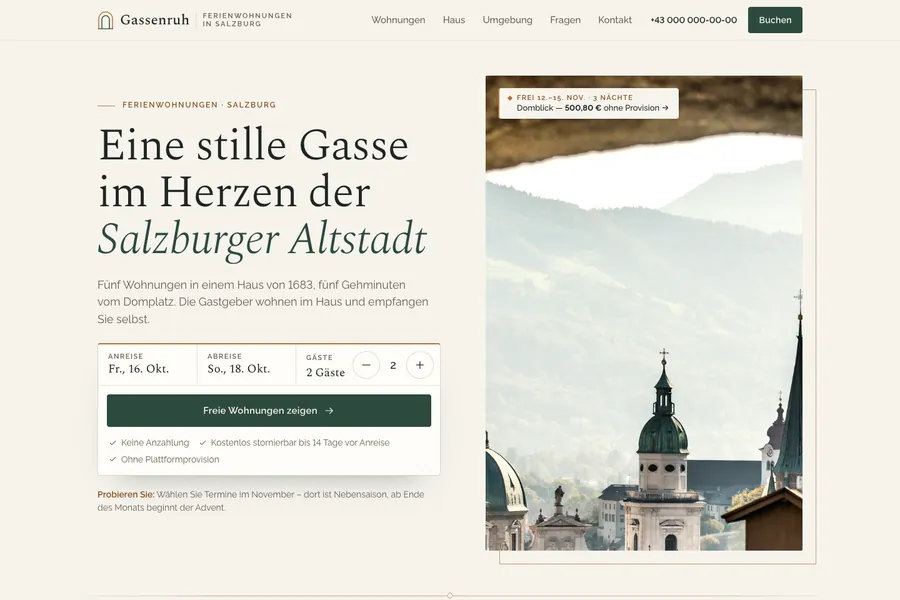
Salzburg is not Limassol or Valletta, but the logic travels: the guest sees the whole price before writing, and you get an enquiry with dates already in it. Answering the midnight check-in question can be handled in WhatsApp as well; we wrote about that in WhatsApp chatbot for a small business.
The two side by side
| What we compare | Channel manager | Own booking page |
|---|---|---|
| Same nights open on every platform | Yes, that is the job | Only if it reads the same calendar |
| Brings new guests | No | Only people who already find you |
| Takes a direct booking | Only with an add-on, if the vendor has one | Yes |
| Platform commission | Platform bookings still carry it | No commission on direct bookings |
| Answers guest questions | No | Form and WhatsApp |
| Work left for you | Less manual blocking | Confirming enquiries, taking payment yourself |
Where the two meet
Here is the catch. A calendar on your own page is a third calendar. If you keep it as a separate list and update it by hand, you have added a channel to sync, not removed one. There are two honest ways to handle it.
The first is request-only, as in the Gassenruh example. The page shows dates as a guide, every enquiry reaches you on WhatsApp or by email, you confirm it, and only then block the nights everywhere. That works for three to ten rooms while direct enquiries are a handful a week. If you would rather see what a free tool gives you before building anything, we covered it in Free booking system for a small business.
The second is live availability, where the page reads from the same source as your channel manager or property system. It is more work, and it only exists if the system can feed a website calendar. Ask the vendor before you buy, not after.
So it is not either/or. The channel manager guards the platform side, and the page is the front door for everyone else. If all your guests come from two platforms and you do not want direct bookings, calendar links or a channel manager are all you need, and you can skip the page. If you already use a hotel system with a booking engine you like, a better-looking page in front of it may be the only missing piece.
What direct bookings cost you
No commission, but there is time: messages, confirmations, taking the payment yourself (payment services have their own fees), and no platform review score to lean on. A stranger may reasonably prefer the platform. Direct bookings are mostly for people who already know you, such as guests who stayed before, people who found you on Google or Instagram, and friends of friends. Put the link where they look: your WhatsApp profile, your Google Business Profile, a card in each room. For a booking that came through a platform, read that platform's terms before you move the conversation elsewhere.
Rules are local. Registration of short-term rentals and tourist tax depend on the country and the municipality. The European Commission says its short-term rental rules are now applying across Europe, with registration procedures introduced by national authorities (European Commission). Ask your local authority what applies to your property before you put prices online.
What to do today
- Open your Airbnb host calendar settings and check which calendars are connected and when each one last updated.
- Count the double bookings and the manual date blocks of the last twelve months. Two bookings or an hour a week is your sign to look at a channel manager.
- List your last ten direct enquiries from WhatsApp, phone and email. The first question in each is what your page should answer.
- Ask your municipality which registration number and tourist tax rules apply to your rooms.
- Write down what a guest must see before writing to you: dates, full price, cancellation rule, how to arrive. With that one page of notes you can brief a freelancer, us, or yourself.
If you want, we'll do it for you
We build company websites around your brand, from scratch rather than from a template: from €580, ready in 2–3 weeks. The price covers a call about what you offer and to whom, custom design, as many pages as your business needs (apartments, location, contact), all the copy prepared by us and sent to you for review, a site you can edit yourself, SEO basics, a visit counter and ad pixels, and a short enquiry form that lands on WhatsApp, by email, in a spreadsheet or in your CRM. We publish on your domain, with the code, domain and access registered in your name. Revisions are free until you accept, and we fix bugs for 6 months after launch at no charge. Price and timeline come in writing before we start, you pay half up front and half after acceptance. The price is lower because experienced specialists work faster with AI tools.
A second language for the site is an add-on, and for a guesthouse it is often the one that matters; we adapt the text to the market instead of translating word for word. A live availability calendar with a price calculation, like the one in Gassenruh, is not on the standard list. Tell us how it should work on the free review, and we put what it costs in writing before we start. We add nothing without your consent. Message us on WhatsApp and we reply within an hour during working hours.
Sources
- Airbnb Help Centre: syncing calendars, checked 30 October 2026.
- European Commission: new rules bring increased transparency to the short-term rentals sector, checked 30 October 2026.