Custom CRM for a small business: when building your own beats a subscription, and when a ready-made one is enough
Build your own CRM when your process doesn't fit the stages and fields of a ready-made one, when a growing team makes per-user fees add up, or when you want the server and the data in your own name. With one pipeline and one or two people, take a ready-made CRM and set it up yourself. We don't configure those, and a team that small doesn't need us. If you do build, a custom CRM for a small business is a matter of weeks: our Mini-CRM costs from from €480 and takes two to four weeks.
What "custom CRM" means here
Search for a custom CRM and three different things turn up under one name.
Some people mean CRM development from scratch: your own code, your own scope, a project of a different size altogether. Others mean a white-label CRM, which is another company's product with your logo on it. That suits an agency that resells CRM; for running your own requests it changes the logo and nothing about the process. This article is about a third thing: a small CRM built around your process on an existing engine, with your stage names, your fields and your roles, ready in weeks.
When a ready-made CRM is enough
Start with an honest look at your own process. If a request goes from first message to quote to payment, and one or two people handle it, a ready-made CRM will do the job. HubSpot's pricing page lists a free plan for up to 2 users and 1,000 contacts. Sign up, rename the stages, import your spreadsheet, and see whether anyone still opens it a month later. If they do, you have your answer and you've saved yourself a project.
We don't configure ready-made CRMs, so this is easy advice to give. One exception: if all you want is for website requests to land in the CRM you already use, we can pass them there.
Where a ready-made CRM starts to pinch
Three things usually decide it.
Process comes first. A car repair shop thinks in diagnostics, work orders and cars ready for collection. A generic pipeline thinks in leads and deals. You can rename the stages, but the facts the shop cares about (the car, the job, the parts, the total) have no natural home, so they drift into a notes field or back into a spreadsheet beside the CRM.
Then the bill. Kommo's entry plan is listed at $25 per user per month, billed in US dollars, with a minimum subscription of six months. For two people that is small money. For eight people it is four times that, every month, and it rises with every hire. Our Mini-CRM has no subscription and no per-user fee. You pay for the build, and you pay the hosting company directly for the server, which is registered in your name.
That trade cuts both ways. A large vendor's product usually has more features than a small CRM, and you rarely have to think about a server. Ours does what your process needs and no more; in return the data, the access and the server are yours, and you can export everything to a spreadsheet whenever you like.
Last, where requests actually arrive. They come in on WhatsApp, in Instagram DMs, through the website form, as missed calls. If the CRM sees none of that, managers keep working in the chats and copy things across when they remember, which is to say sometimes. A CRM that receives the website form and WhatsApp as cards removes the copying. Instagram, calls and email can be connected as well, each as a separate job and only through official routes; there is more on that under AI automation. And if you want those customers answered on WhatsApp too, we wrote about what a WhatsApp chatbot can do for a small business.
Ready-made or your own: a quick test
| Where you stand | A ready-made CRM is enough | Build your own |
|---|---|---|
| Pipeline | One standard sales pipeline, a handful of stages | Stages and fields from your trade: diagnostics, work orders, deliveries |
| People | One or two users | A team where each person should see only their own requests |
| Where requests come from | Email and one web form | WhatsApp, the website form, calls and spreadsheets, in one feed |
| Cost as you grow | You're fine paying per user | You'd rather not pay for every new seat |
| Data | Happy for it to sit with the vendor | You want the server and the access in your name, with export on demand |
| Habit | The team opens it every day | The team lives in chats and Excel |
Count the cells you recognise in the right-hand column. Three or more is a reason to talk to us. Two or fewer, stay with a ready-made one.
A repair shop in Leipzig
Garaż 17 is one of our CRM works: a car repair shop in Leipzig, with the site in German. It starts from a spreadsheet with FINAL(2) in its file name, the kind where two cars are entered twice and six of ten rows have no owner. The CRM replaces it with a board: New, Diagnostics, In repair, Ready. A card moves to the next stage with a drag or an arrow, and each card holds the car, the work, the parts, the total and the message history.
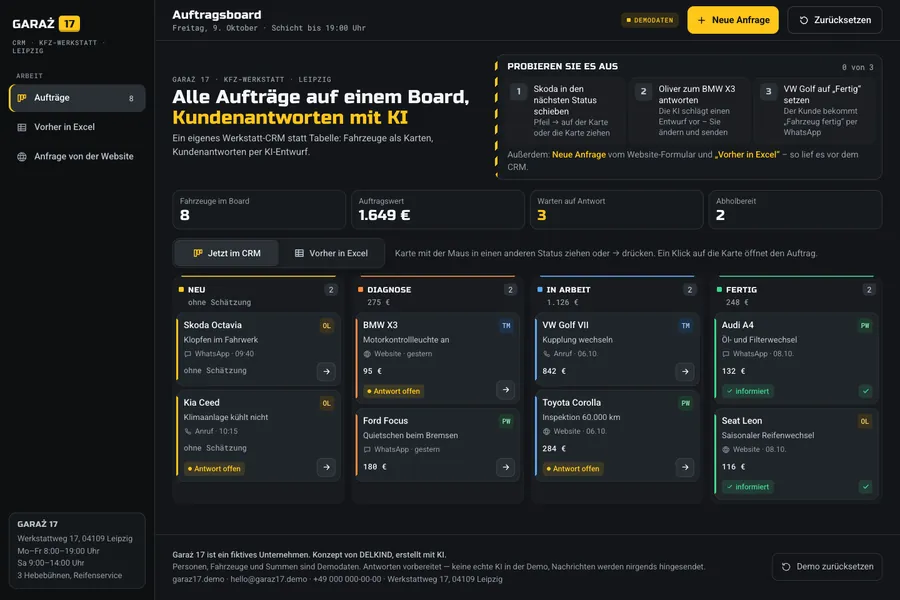
A request from the website form appears on the board by itself. The AI prepares a draft reply to the customer, the foreman edits it and sends it, and when a car is moved to Ready, the message that it can be collected goes to the customer on WhatsApp with one click. The work opens with three small tasks: move a Skoda to the next stage, reply to a BMW customer, put a VW Golf on Ready. You can try them in the Garaż 17 CRM work. The gallery also has CRMs for a beauty salon, a renovation firm and a dental clinic.
What to do today
- On one sheet, write the path of a single request from first message to payment, stage by stage. If you need more than a handful of stages, or a branch, mark where.
- List every place requests arrive: WhatsApp, Instagram, the website form, calls, email. Mark the ones that end up in a spreadsheet.
- Write down who needs to see which requests. If the answer is "everyone sees everything" and there are two of you, stop here and use a ready-made CRM.
- Open the pricing page of any CRM you're considering and multiply the per-user price by the number of people you'll have in two years. While you're there, check the billing currency and the minimum term.
- Try a free plan for a month, with real requests. If the team is back in the chats by the end of it, you've found where the process doesn't fit.
If you'd like, we'll do it for you
Our Mini-CRM, from from €480, is a custom CRM on our engine, built around your process. Prices exclude VAT. Payment is 50/50, the second half after acceptance, and we fix the price and timeline in writing before we start. In the price:
- a call about your process: how a request reaches payment, where it comes from, who handles it and where it gets lost;
- a pipeline with your stage names and fields, nothing extra;
- the website form and WhatsApp connected, so each request lands as a card with contact, source, message history, notes, an owner and a next task;
- a WhatsApp message to you and your managers about every new request, and roles so that a manager sees only their own requests;
- AI that replies to the customer about a new request and gives the manager a short summary, with a label so the customer knows it is AI;
- your customers and deals moved over from Excel or Google Sheets and checked with you before launch;
- message templates written by us and sent to you for review, and training for your managers on a live example of your requests;
- export to a spreadsheet whenever you like; the data and access are yours;
- free revisions until you accept it, and free bug fixes for 6 months after launch.
There is no subscription and no per-user fee; the server is registered in your name and you pay for it directly. Maintenance is optional. The price is lower because experienced specialists work faster with AI tools.
If the Mini-CRM turns out to be too tight, we build a CRM around your process: your own sections, roles and reports, and connections to your services, with the code handed over to you. That takes 4 to 8 weeks, and we price it after the review, which is a free 15-minute call. Details and a live demo are on the CRM with AI page.
Sources
- Kommo pricing, checked 30 October 2026: plan price per user per month, minimum subscription period, billing in US dollars.
- HubSpot CRM pricing, checked 30 October 2026: free plan for up to 2 users and 1,000 contacts.