Starting a small business in the EU as a foreigner: the first steps and the online basics you need on day one
If you want to start a business in Europe as a foreigner, do the paperwork and the shop window in parallel. The paperwork depends on the country and on your own situation, so the only safe starting point is that country's official portal, and a lawyer or accountant on the local side. The shop window is the same everywhere: a domain, a mailbox, a website with your company details and a privacy policy, and a phone number people can reach on WhatsApp. That part you can finish in a week, and it doesn't wait for anyone's stamp.
This article is about that split. It is not legal advice, and we say where it stops.
Start with the official portal, not a blog
Every EU country has its own rules, and they change. The EU's Your Europe site puts it plainly: depending on the country, you may be able to choose from several legal structures, and these differ in liability, taxes, setup costs and ownership. It also says you will usually need to register your business and, in some cases, apply for specific permits or licences.
The same page says Points of Single Contact have been set up in each EU country to help with company registration and with permits or licences. Wherever you plan to register, that is where the real questions go: can a non-EU citizen register a company here, which forms exist, what address is required.
One detail from that page is worth reading twice. The right to set up a business in any EU country (and in Iceland, Norway or Liechtenstein) is described there for EU citizens. The page doesn't say what applies if you are not one, so ask the Point of Single Contact in the country you have in mind. Nobody can answer that from a blog post, including us.
A rough order that works for most people:
- Find your country's Point of Single Contact through Your Europe and read what it says about foreigners.
- Ask a local accountant which legal form fits what you actually plan to sell.
- Check whether you need a permit or licence for your activity.
- Ask about VAT. The same Your Europe page says most businesses operating in the EU must register for it, sometimes only after turnover passes a threshold, sometimes earlier depending on the activity.
Estonia's e-Residency: what the official site says
A lot of people who search for "e residency estonia company" want to know whether it is a shortcut. Here is only what the official site states.
E-Residency of Estonia is described as a government-issued digital identity that gives global entrepreneurs remote access. The site's own steps: apply and pay the fee, pick up your e-Residency kit, then use the ID card to register a company online. The state fee shown for the application is €150. The site's main page lists becoming an e-resident at 3–8 weeks and starting the company at 1–2 days. The application page breaks the wait down further: an identity check of up to 30 days, then 2–5 weeks for the card to be produced and delivered.
So the company part is quick once you have the card. The card itself is the wait.
What we haven't verified, and won't guess at: taxes on an Estonian company run from another country, what it means for your residence, and which banks will open an account. Those questions have different answers depending on where you live. They belong with an accountant who knows both countries. The e-Residency site is the place to start reading; we link it below.
The online basics you need on day one
Whatever legal form you pick, a customer will meet you online first. Here is the short list, in the order we'd do it.
A domain in your name. Register it yourself, with your own account. If a freelancer buys it for you and disappears, you can lose the address your business cards will carry for years.
A mailbox on that domain. name@yourcompany.com looks like a business. A free webmail address looks like a side project. It costs little and takes an hour.
A phone number on WhatsApp. Many customers would rather send a message than call. Put one number on the site and use it for customers only. A separate number is cleaner than your private one, especially once you have a second person helping.
A website with real details. Who you are, what you sell, how to reach you, and your company details once the company exists. Some countries expect business sites to show certain company details; ask your Point of Single Contact or accountant what applies to you, then put them on a page with an obvious name. Ours is called Legal notice.
A privacy policy and a cookie banner, if the site collects anything. For the banner side, see our piece on cookie banners. Whether you need a policy and what it must say depends on your country and your tools; ask a lawyer.
A Google Business Profile, if customers search for you on a map. We covered the setup in Google Business Profile for a small business.
What the website needs to do in week one
You don't need ten pages the week the company is registered. You need one page that answers four things in a few seconds: what you sell, who it is for, what it costs or how pricing works, and how to contact you.
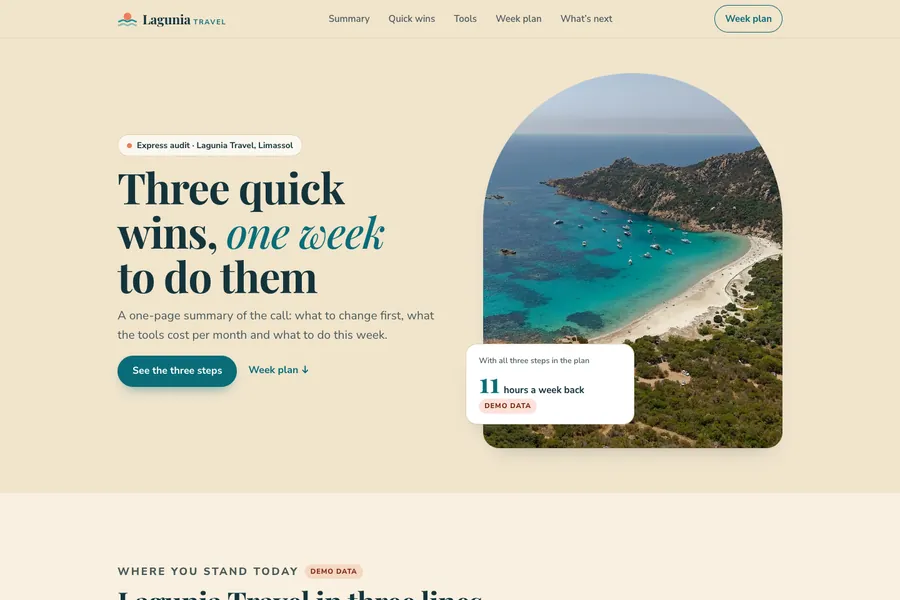
Take a service business with a clear first step. The work below is an example from our portfolio: a travel agency in Limassol, with the whole site in English. Its express-audit page is a one-page summary of a 30-minute call. It sets out the business in three lines, the three quick wins, the tools and what they cost per month, and a plan for the week. A new company needs the same discipline from its first page: one screen of business facts, a short list of next steps, a way to ask for more.
A few things we'd skip at this stage: a blog, three languages, an online shop. Add them once the first page brings requests. If you are comparing what a company site costs once those are added, Company website cost in the EU explains what moves the price. For one page, Landing page cost in 2026 covers what studios charge.
Mistakes we see with people who are new to a country
- Buying the domain through someone else's account. Then they hold the keys. Ask for the registrar login in your name.
- Using a private phone and private email for the business. It works for a month. Then a customer's message is buried between family chats.
- Copying another company's legal pages. Their policy describes their tools, not yours.
- Waiting for the company to exist before building anything. The site, the domain and the mailbox don't need a registration number. Only the details page does.
- Hunting for one trick that makes it all easy. There isn't one. The official starting points above are slow because they check things.
What to do today
- Open Your Europe and find the Point of Single Contact for the country where you want to register.
- Write down the three things you will sell first and what each costs you to deliver.
- Register a domain under your own account and set up one mailbox.
- Get a phone number for the business and switch on WhatsApp Business on it.
- Draft the four answers your first page has to give: what, for whom, how much, how to reach you.
If you'd like us to do the website
We build a one-page website for a new business: landing page, from €380, ready in 3–7 days. The price covers a design built around your brand, a call before we start, copy written for you and sent for your review, a phone and a laptop layout, light animations, SEO basics, a visit counter and ad pixels, and a short form whose requests reach you on WhatsApp, by email or in a spreadsheet. We publish it on your domain, and the code, domain and access are yours. Revisions are free until you accept the page, and we fix bugs for 3 months after launch.
Price and timeline are written down before we start, and you pay half up front and half after acceptance. We work with AI tools, and experienced specialists work faster with them, so the price comes out lower. We reply within an hour during working hours.
Sources
- Your Europe: Starting a business, checked 9 November 2026
- e-Residency of Estonia, checked 9 November 2026
- e-Residency: become an e-resident, checked 9 November 2026